Kingbeast's Lair

Growling about the RPG industry and my gaming life. RPG and anime reviews from a passionate fan. (Formerly John's Hero HQ.)
Subscribe

Review Of Trail Of Cthulhu By Pelgrane Press
April 02, 2013 By: John Taber Category: Games, Product Reviews

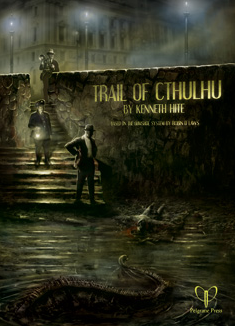
Trail Of Cthulhu Front Cover

-== What is it? ==-

Trail Of Cthulhu (TOC) is a horror RPG based on the writings of H.P. Lovecraft and the investigation based Gumshoe rules system from Robin Laws. The book focuses on the 1930’s but this can easily be adjusted by the GM. It was written by Kenneth Hite and published by Pelgrane Press in 2007. With a pedigree of Robin Laws and Kenneth Hite my expectation for TOC are very high. I consider these two gentlemen to be some of the best RPG authors in the business. 😉

TOC has a color cover and a three color interior. The interior text is black and white but there is dark green shading to add atmosphere. The hardcover version of TOC is 8.5” x 11” and is 248 pages in length. I am reviewing a print copy that I bought from Pelgrane Press. I ran six sessions of TOC using the Purist rule set as part of my Armitage Files campaign. (Watch this very blog for a review of the Armitage Files.)

-== What I Like ==-

TOC uses the Gumshoe system previously presented in Esoterrorists but skins it for Cthulhu. The primary enhancements are the addition of rules for Stability/Sanity loss, spell-casting, and tomes. In these areas the product does a pretty good job. My group had little issue with the Stability rolls and seemed to take to them quickly even though as a GM I had some minor issues with them (see below). I do not plan on discussing the Gumshoe system in detail. If you want to read more about it you can check out my Esoterrorist review here. 🙂

The TOC rules cover two styles of play. There is a Purist mode and a Pulp mode. Purist mode is straight horror similar to that found in the Call Of Cthulhu RPG. Pulp mode is two guns blazing against deep ones. 🙂 For my campaign I used the straight Purist mode.

The rules presented in TOC are very fast. I think pushing role-playing over gameplay works well for the horror genre. You don’t get caught focusing on strange rules you move along quickly. The game enforces this aspect of play really well with the Scene card mechanic. After all of the major clues are uncovered the GM holds up a card with the word “Scene” written on it. This lets the players know that they have all of the critical information related to the investigation. There could be details gained by further research but the major important clues are out. The Scene card worked great because it never seemed to distract from the role-playing. In fact I plan to steal the idea for other campaigns that I may run.

The investigative engine present in Gumshoe is a perfect fit for the Lovecraft horror genre. Often the research about a particular nasty is more important than your shotgun. The system naturally supports the style of gameplay that you want to evoke at the table.

I really liked the way the Drive statistic is used to provide character motivation. When creating their characters players pick a motivation, or Drive, for their PC. For example, Curiosity. If they go against their drive they can incur a Stability loss. The mechanic worked well and the players enjoyed the interaction that Drive had on our gameplay.

I really like the artwork and layout in TOC. Even though there is dark green shading behind the text it is not distracting. The artwork can be dark but it really evokes the setting. Jerome Huguenin also knocked it out of the park with a fantastic cover.

-== What I Don’t Like ==-

One of my players pointed out that there are several “influencing people” skills without clear boundaries. I agree. I made some subtle changes in my campaign that really helped. I removed Flattery and rolled it into Reassurance. I removed Interrogation and rolled it into Intimidation. I flat out pulled Oral History. Those changes worked pretty well for us. It cut down on complaints and confusion quite a bit. 😉

Several of the players did not like the fact that in TOC Purist rules investigators do not earn experience. I came up with something that is not as open as the Pulp play style but is similar. Here is what I did.

  • For each session that a player attends his PC gets 1 ep.
  • This ep can be spent to get +1 on a General Ability.
  • 5 ep can be traded in to get +1 on a Investigative Ability.
  • The rules say that points can be redistributed during the course of a campaign.  I allowed this initially.  After the 5th session I did not allow point shifts.
  • Per the rules ep cannot be used to increase Credit Rating, Cthulhu Mythos, or Sanity.
  • Stability or Health can generally not be raised unless approved by the Keeper.

The way General Ability pools work in the Gumshoe system was something that my group could not accept. Lets say a PC has 9 points in Firearms. A tough bad guy might need a 4 to hit on 1d6. That means I can spend 3 and automatically hit. So for the first 3 rounds of combat I will hit every time. Once my pool is gone the PC all of a sudden becomes a lousy shot. It just does not make sense. This was by far our biggest issue with TOC.

The chances for a PC to lose Sanity are very hard to achieve.  Every PC in my game had 8 to 10 Stability.  You don’t lose Sanity unless Stability is knocked below 0 and it is a Mythos attack.  Getting attacked by a horrible beast only loses you 5 Stability max.  Not sure the math plays out unless the GM whittles away at the Stability before that last encounter quite a bit.  I started trying this but I am still not comfortable with it.

The way Investigative Abilities work when involved with the persuasion related effects is not wonderful. If I have Assess Honesty I cannot be fooled unless the other person is an actor or trained then it does not work at all. If two Investigative Abilities play against each other there is literally not a mechanic for resolving the situation. It the call of the GM. I think rules are needed for this situation.

-== Summary ==-

I found this TOC review particularly hard to write. The reason is because I am a huge fan of Ken Hite and Robin Laws. I consider them both master RPG designers . At DunDraCon this year Ken mentioned that he and Robin have learned a lot about making the Gumshoe system easier for folks to “grok”. After every Gumshoe release the system clarifies. Me and my players could use some of that clarification. We actually switched from TOC to Call Of Cthulhu after 6 sessions. This is a product with some standout concepts that is brought down by a few severe problems.

You can get copies of TOC at Noble Knight Games at this URL for $25. Amazon has copies for $39.99 at this URL. You can get the PDF from DriveThruRPG at this URL for $24.99.

I give it 6 out of 10 paws.

Reverb Gamers – Questions 11 Through 15

March 14, 2013 By: John Taber Category: Games, Growlings

Reverb Gamers LogoIn 2012 Atlas Games came out with a list of 31 RPG related questions that they wanted people to answer. I will tackle them in small bite sized morsels to make them a bit easier to swallow. Here are the next set of questions.

REVERB GAMERS 2012, #11: Have you ever played a character that was morally gray, or actually evil? Why or why not? If yes, did you enjoy it?

I’m primarily a GM so I often play morally gray or downright evil characters. Some of these characters I have been played over extended periods (i.e. recurring villains). At times I have played characters that are very twisted. A few years ago I ran a campaign set in Victorian times that had Cthulhu overtones. In one particularly memorable session I used a fantastic published adventure called Sacraments Of Evil. The villain was a God fearing man who twisted Catholicism into something that was quite insane. The final scene was terribly tough to play but carried so much impact that the players sat stunned for a few seconds. Was this villain “fun” to play…yeah, as I GM I relish giving my players reason to pause…but I don’t think that says anything about me as a good Catholic person. 😉

REVERB GAMERS 2012, #12: Do prefer collaborative or competitive games? What do you think that says about you?

I far prefer collaborative games. I really like it when everyone is having fun. On rare times when playing competitive games people who lose can be put off by the situation. Why meet with friends then have something happen like this? Boo hiss. I’m also a big lover of teamwork. Cooperative games really enforce teamwork. This is another reason why I love RPG so much. The GM may oppose the players but the goal of an RPG is to have fun telling a story as a group.

REVERB GAMERS 2012, #13: Who’s the best GM/storyteller/party leader you’ve ever had? What made him/her so great?

This one is really hard…I have played with a lot of really wonderful GMs over the years. One of my favorite GMs is Derek Hiemforth. Derek does a lot of things right as a GM. He makes sessions build in excitement then hammers home a great ending. Derek has a nice way of laying out mysteries. He lets out clues at just the right rate and mixes in encounters to keep everyone on their toes. Derek does a great job playing NPC. Often I end up laughing along with the other players at an NPC.

REVERB GAMERS 2012, #14: What kinds of adventures do you enjoy most? Dungeon crawls, mysteries, freeform roleplaying, or something else? What do you think that says about you?

I really love high-adventure gaming sessions. When I can swing from the chandeliers, jump from moving cars, and ride on the back of dangerous monsters I am a happy camper. Sometimes if my dice are against me this can be a dangerous proposition but that is part of the fun. I think loving high-adventure sessions says that I need to escape from my mundane world every so often. It also says that I have wild impulses that I like to play out in a safe environment. I’m a very tense person…this is my release.

REVERB GAMERS 2012, #15: People often talk about the divide between what happens “in game” and “in real life.” Do you maintain that divide in your own play, or do you tend to take what happens to your character personally? Why?

I definitely do not take things that happen to my character personally. So often things happen in games that are really bad or unintentional. At times the mood of a session can affect me afterwards but this is not an example of “what happened in the game affecting my real life” it is “what happened in real life affecting my real life”. 😉

GAME ON! 😀

Review of Busy, Busy Airport By I Can Do That Games

March 07, 2013 By: John Taber Category: Games, Product Reviews

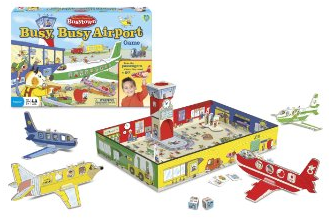
Busy, Busy Airport

-== What is it? ==-

Busy, Busy Airport (BBA) is a family board game by I Can Do That Games. It is marked for ages 3 and up. It takes roughly 30 minutes to play.

The product is comprised of a sturdy colored box, 4 cardboard airplanes with plastic stands, a control tower dice tower, 4 cardstock destinations, 16 cardboard passengers, 16 cardboard souvenirs (4 sets numbered 1 to 4), and two custom dice. The dice are marked with passenger or destination with values of 1 and 2. I have played BBA many times with my kids.

-== What I Like ==-

The gameplay in BBA is very simple. Each player starts with an empty plane. The bottom of the box is configured to hold the passengers and the dice tower. Around the house the 4 destinations are placed. On each destination 4 souvenir cards are placed face down. The first player rolls the dice using the fancy control tower. He picks the one dice that he wants to use. Initially players want to get passengers for their plane. Each passenger has a specific destination. After getting up to 3 passengers the player uses a destination roll. For each passenger that is dropped off the player takes one of the face down souvenir cards. They place these in the cargo slot in their plane then return to the game board. This repeats until there are no more passengers. Once the last passenger is taken each player gets one more roll then the game is over.

The cardboard planes in BBA are very nicely decorated. They include funny pilots and plane parts. The planes are made of thick cardboard which makes them durable. The only problem we have had with the planes is actually with the stand. The stands start to bend apart after some use. Applying a bit of scotch tape to the plane resolves the issue. The other issue with the planes is with the cargo slot. I really wish it could hold all of the cargo that you might collect over the course of the entire game. Right now you have to return to the airport and empty out the cargo slot. This is really only a minor issue.

The control tower dice tower is really fun. The kids love clattering the dice down into the box. 🙂

The artwork for the airport (i.e. bottom half of the box) is very well done. It is full of Busy Town characters doing their normal chaotic things. The outside edge of the BBA box is decorated like a boarding gate for each plane. This makes a nice touch as the kids like to sit in front of their boarding gate.

-== What I Don’t Like ==-

There are a LOT of small pieces to this game. During the course of a BBA session the planes, passengers, and souvenirs are carried all over the house. Imagine small cardboard pieces that travel all over the house. You guessed it! It is really easy to lose these suckers. In fact I have nicknamed this game, “Busy, Busy Run All Around The House And Pickup The Little Pieces”. 🙂 The cargo cards as especially troublesome as they are small and made of very thin cardstock. These can easily get blown off of target destinations. The passengers tokens are a better size and heavier cardboard but these start to fray at the bottom edge when getting placed in the planes. Pressing them together or peeling off a layer of cardboard seems to address the issue.

My kids loves to place the destinations all over the house when we play BBA. This means they are often alone when picking up their souvenirs. It did not take long for my conniving…I mean clever…8 year old to start cheating. He goes to a destination then takes the highest numbered tokens for his passengers. This is really hard to prevent during game play.

As the dice determine if the player can pickup passengers or visit destination it can be quite frustrating to younger players. My two boys often want to keep rolling until they get a result that they desire. There is also a lot of randomness in picking up the souvenirs. Overall BBA does not have too much strategy.

The rules in BBA are VERY short. In my opinion they infer that a player is not supposed to count the values on their souvenirs until the end of the game. As the souvenirs are placed in the plane it is hard to avoid glancing at their values. In fact looking at the cargo values does add a teeny bit of strategy to the game. If for example I know that 3 and 4 are gone from the City I might pick passengers from a different destination when filling my plane. This tactic is a bit tricky for younger players to grasp.

-== Summary ==-

After playing Busy Town Eye Found It I was really hoping the Busy, Busy Airport had similarly wonderful gameplay and components. I would actually give the product a much lower score except my kids still love to play it. I guess that is more important than pleasing the adults. 🙂 If you are looking for a fun game with toy airplanes you could pickup BBA. If you are looking for a great family game pickup Busy Town Eye Found It. 😉

Amazon has copies at this URL for $21.95.

I give it 6 out of 10 paws.